
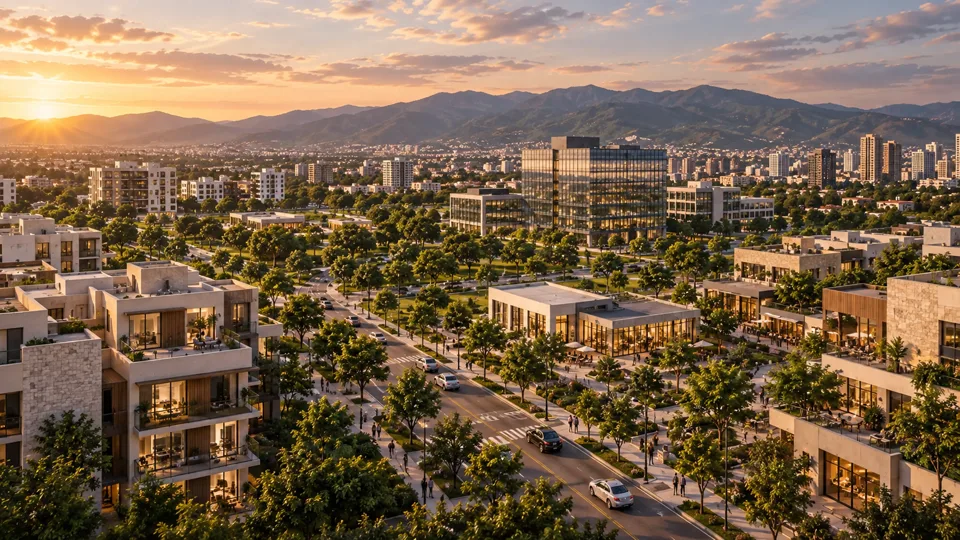
Mexico’s real estate markets: 14 cities and a framework for comparison
INMO1’s national guide to comparing 14 real estate markets by demand, product, infrastructure, absorption and risk, without misleading averages.
Read analysis →Playa del Carmen is a city of residents and jobs as well as a tourism destination. How to interpret population, connectivity, hotels and absorption.

Playa del Carmen is often analyzed solely as a vacation destination. That perspective is no longer sufficient. The city brings together permanent residents, employment, services, regional mobility and tourism supply. A project’s viability depends on identifying which of these sources of demand it intends to capture.
Between 2010 and 2020, the municipality of Solidaridad grew from 159,310 to 333,800 residents, an increase of 109.5%. The town of Playa del Carmen grew from 149,923 to 304,942 residents. In addition, 21.3% of the population living there in 2020 had lived in another municipality five years earlier; among those moves, 59.4% were reported as work-related.
Population expansion and work-related migration suggest demand for housing, rentals, retail and services. They do not automatically indicate the purchase price a household can afford, the commute it will tolerate or whether it seeks ownership, a short-term rental or a long-term rental. Translating population into an addressable market requires income, employment, household formation, mobility and competition by corridor.
An apartment for a local worker, a second-home unit and a vacation rental product can share a postal code while competing for different buyers, financing and amenities.
The 45.6 km, double-track Cancún Airport–Playa del Carmen rail section opened on February 29, 2024. The new connection changes accessibility and may expand tourism and commuting routes. However, its real estate impact varies with proximity, transfers, frequency, cost and the final connection to each project.
Infrastructure improves potential; demand emerges when users can and want to choose the product. The analysis must compare door-to-door travel times, rather than just distance to the station.
In December 2025, SITUR recorded 316 hotels and 47,639 rooms. For 2025 as a whole, it reported 1,645,198 tourists, 6.3% fewer than in 2024, and occupancy of 70.8%, compared with 75.3% the previous year. Between January and June 2026, occupancy was 72.58%, down 4.47 percentage points from the same period in 2025.
These figures relate to the hotel establishments being monitored. They do not include all vacation housing or establish an equivalent decline in residential sales. They do show that growth in infrastructure and rooms does not eliminate competition for room nights, visitors and spending.
| Market | Key variable | Evidence required |
|---|---|---|
| Local housing | Income and commuting | Purchase price, monthly payment and comparable rent |
| Second homes | Use and origin | Profile, stay and liquidity |
| Vacation | Occupancy and net rate | Seasonality, expenses and future supply |
| Mixed use | Everyday demand | Flows, retail and operations |
Playa del Carmen has an urban scale of its own. The challenge is no longer to establish growth, but to choose which demand to serve and with what product, price and pace.
For a specific asset, INMO1 defines the submarket, surveys competitors, standardizes product and price comparisons, verifies inventory and estimates absorption using a consistent definition. It then connects these findings to product, phasing, capital and sensitivity. This work helps distinguish a favorable trend from a defensible opportunity in Playa del Carmen.
Compare this market with the guide to Mexico’s real estate markets. Learn more about the scope of a real estate market study, real estate feasibility and supply, demand and absorption analysis.
Are you assessing land, a development or inventory in Playa del Carmen? Request a diagnostic consultation with INMO1.
Editorial cutoff date: September 18, 2026. Figures retain the geography, unit and period of their source. Demographic, tourism or economic context does not by itself establish demand, sales, absorption or real estate returns.
INMO1’s national guide to comparing 14 real estate markets by demand, product, infrastructure, absorption and risk, without misleading averages.
Read analysis →
A guide to combining INEGI, SHF, Banxico, SNIIV and Data México without confusing population, prices, credit, advertised supply and effective demand.
Read analysis →
Absorption, inventory, product mix and achieved prices are the four indicators that determine a project. We explain each one, how it is measured and why the data source changes the result.
Read analysis →